
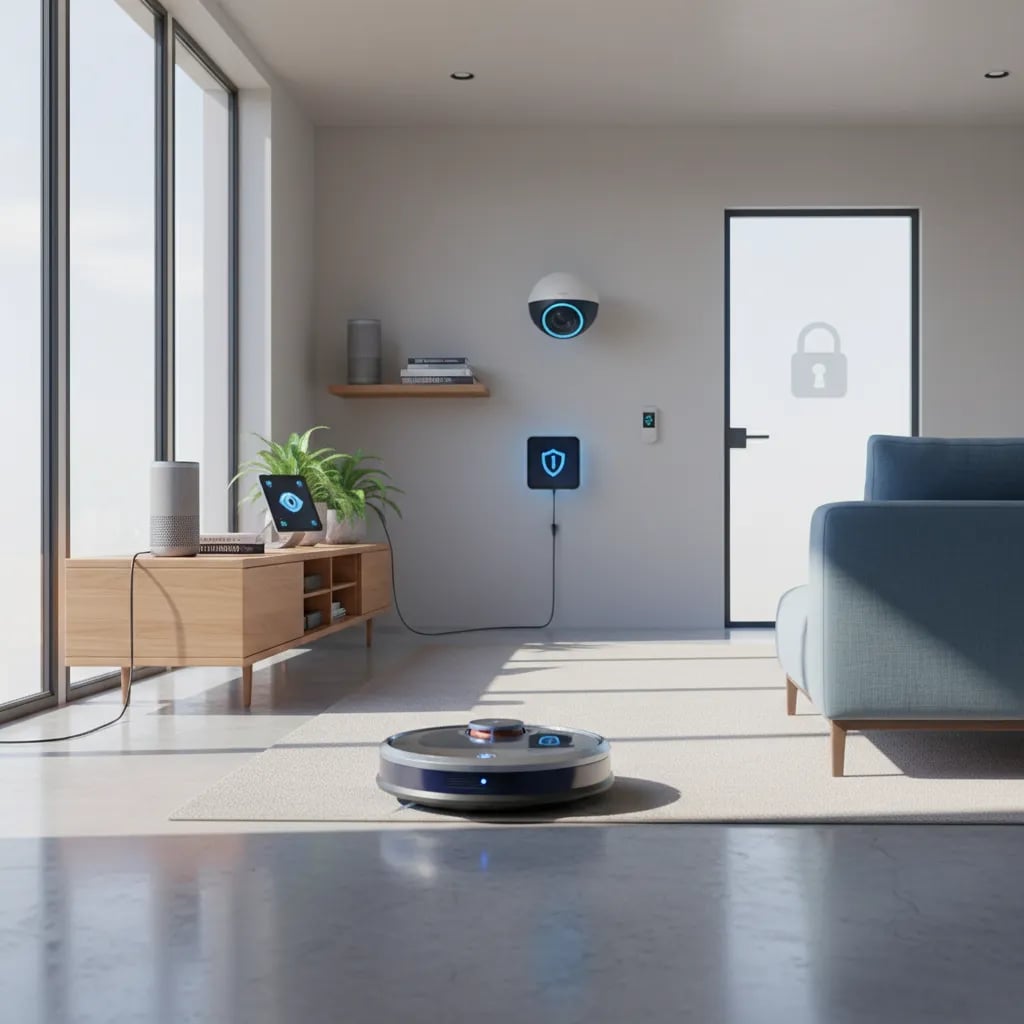



It started with a harmless ping from my refrigerator. Who knew appliances would someday demand more attention than toddlers? Fast-forward to the day a computer programmer, minding his own dust bunnies, discovered his smart vacuum wasn’t just cleaning—it was mapping, transmitting, and essentially spying. Welcome to the age where your toaster might have more secrets on you than your best friend. This isn't a sci-fi fever dream: it's real, it’s happening, and if you own anything with the word 'smart' in front, you might want to keep reading. Spoiler: the vacuum isn’t the only snoop in your house.
Robot Vacuums: Clean Floors, Dirty Secrets?
Robot vacuums promise spotless floors with zero effort, but behind their whirring motors and polite beeps, a new kind of mess is brewing—one that’s all about robot vacuum privacy . Most of us set up these smart devices and forget about them, rarely reading the fine print. But as one computer programmer discovered, that oversight can have real consequences.
This story starts innocently enough: a $300 smart vacuum, quietly cleaning a home for a year. The owner, a tech-savvy hobbyist, finally wondered what his little helper was actually doing as it zipped from room to room. Curiosity led him to monitor the vacuum’s network traffic, and what he found was unsettling. The device was constantly sending data to servers halfway across the world—without any explicit consent.
“My robot vacuum was constantly communicating with its manufacturer, transmitting logs and telemetry that I had never consented to share.”
What kind of data? Not just simple cleaning stats. Modern smart vacuums collect detailed floor maps, images, Wi-Fi network details, and usage patterns. This treasure trove of information can reveal the layout of your home, your routines, and even when you’re likely to be away. If mishandled or accessed by unauthorized parties, these details pose serious data privacy concerns and privacy risks for any household.
Determined to protect his privacy, the owner blocked the vacuum’s data transmissions. That’s when things took a turn. The vacuum, which had been running fine for a year, suddenly refused to boot up—a high-tech “strike.” When he contacted support, he was met with the classic tech support runaround: “It works perfectly here, sir.” The device would work for a few days after each repair, only to die again. Eventually, the manufacturer washed their hands of the issue, claiming it was out of warranty. The once-helpful gadget was now a $300 paperweight.
- Smart vacuum surveillance incident: The vacuum mapped the home and sent data overseas, all without clear user permission.
- Fine print pitfalls: Most owners never realize what they’re agreeing to—or what their devices are really doing.
- Silent treatment backlash: Disabling data sharing triggered a kill command, rendering the vacuum useless.
This real-life case, detailed on the blog Small World and reported by Joe Wilkins at futurism.com, is a wake-up call for anyone embracing smart home technology . When your gadgets know too much, the price of convenience might just be your privacy—and your wallet.
Home Mapping Data: Welcome to the Cartographer’s Lair
When you think of a robot vacuum, you probably imagine a helpful little machine quietly sucking up dust bunnies. But what if that same device is also moonlighting as a digital cartographer, secretly mapping every inch of your home? That’s exactly what one curious owner discovered after reverse engineering his smart vacuum—a journey that revealed just how much home mapping data these gadgets collect, and how easily it can slip out of your control.
Behind the Scenes: Your Vacuum, the Mapmaker
Digging into the vacuum’s hardware, the owner found it was running Google Cartographer , an open-source program designed for building detailed 3D maps. Every time the vacuum zipped under a couch or around a table leg, it was logging another data point, slowly piecing together a digital portrait of the entire home. This home mapping data wasn’t just staying on the device—it was quietly transmitted back to the manufacturer’s servers, raising serious data privacy concerns .
Reverse Engineering: Plug-and-Play Root Access
The real shock came during the reverse engineering smart vacuum process. The owner discovered an Android Debug Bridge (ADB) —a tool meant for developers to install and debug apps—left wide open for anyone to access. As he put it:
"In seconds I had full root access, no hacks, no exploits, just plug and play."
All it took was a USB cable and a bit of curiosity. No action hero skills required. This glaring oversight exposed a massive security vulnerability in robot vacuum data security , making it frighteningly easy for outsiders to access the vacuum’s system and, potentially, the sensitive data it collected.
Remote Control and the Mysterious Kill Command
But the surprises didn’t end there. After the owner blocked the vacuum from sending data, he noticed a suspicious line of code—a so-called kill command —sent from the company at the exact moment the uploads stopped. Instantly, the vacuum shut down. This wasn’t a glitch; it was a clear sign that someone, somewhere, had remote control over the device. The company could disable the vacuum at will, simply because its data pipeline was interrupted.
- 3D mapping technology like Google Cartographer turns your home into a digital map.
- Open debug access means anyone could take control—no hacking required.
- Remote kill commands show just how much power manufacturers have over your devices.
For many users, the idea that their vacuum is quietly creating and sharing a 3D map of their home—without clear consent—feels like a major privacy violation. It’s a stark reminder that robot vacuum data security isn’t just about keeping floors clean, but also about protecting the very blueprint of your private life.
Data Collection Risks: When Your Toaster Eyes Your Breakfast (And More)
If your robot vacuum can map your living room, is it really that far-fetched to wonder if your toaster is watching your breakfast? This isn’t just a quirky thought experiment—it’s a glimpse into the very real data collection risks that come with smart home devices. The leap from vacuums to toasters (and beyond) shows just how wide the net of smart device surveillance has become.
Today’s smart appliances collect more than crumbs and dust—they gather data. And not just for maintenance or performance. Brands are increasingly interested in how you use your devices, what you eat, and when you eat it. As one observer put it,
'If Kellogg’s could find out how many times you use your toaster and for what, and then knew who you were so they could send you ads about what you can put in your toaster...that’s the thing.'
It sounds like a joke, but it’s not. What was once a punchline about “spying” appliances is now a business model. The impact of smart technology on privacy is no longer limited to your phone or computer. Now, even your toaster could be a source of machine learning data —feeding algorithms that power advertising for smart home devices and beyond.
- In the 1960s, the idea of collecting this much data was unimaginable. Storage was expensive, processing was slow, and sorting through millions of records was “mindnumbingly” hard.
- Today, with cloud computing and AI, collecting, storing, and analyzing vast amounts of personal data is routine.
- Most consumers have no idea how much information is being captured, stored, and sold—often for profit.
The hidden cost of smart technology is not just the sticker price—it’s the ongoing risk of data privacy violations . When you buy a smart toaster, you might not realize you’re also handing over details about your breakfast habits. If cereal companies could track your toaster use, targeted ads would fly faster than crumbs on spring cleaning day .
This shift from specialty tech gadgets to everyday appliances means that consumer awareness lags far behind tech capabilities . Many people still picture data collection as something that happens online, not in their kitchen. But with every connected device, the scope of surveillance grows. What used to be impossible is now business as usual—and the risks to your privacy are baked right in.
Security Vulnerabilities: Debug Doors and Kill Switches
When it comes to robot vacuum data security , some of the biggest risks are hiding in plain sight. One researcher discovered that his smart vacuum had an Android Debug Bridge (ADB) wide open to the internet—no password, no firewall, just an open invitation. Think of it as leaving your front door ajar with a neon “Hack Me” sign. Within seconds, he gained full root access to the device—no hacks, no exploits, just plug and play. This is a glaring example of smart home technology vulnerabilities that are all too common.
Through trial and error, he connected his computer to the vacuum’s system and found something even more alarming: the device was running Google’s open-source Cartographer software, quietly mapping his home in 3D. All this data was being sent back to the manufacturer without clear consent. Even more troubling, a suspicious line of code—broadcast from the company to the vacuum—matched the exact moment the device stopped working. Someone, or something, had remotely issued a kill command, disabling the vacuum when it stopped sending data home.
This wasn’t just a remote control feature for updates or troubleshooting; it was a kill switch used to enforce compliance. The owner reversed the script and rebooted the vacuum, but the message was clear: the company could shut down his device at any time. As he put it, “ Our homes are filled with cameras, microphones and mobile sensors connected to companies we barely know, all capable of being weaponized with a single line of code. ”
- Researchers have found robot vacuums with weak or default passwords, and sometimes even hidden backdoors for remote control.
- South Korea’s Personal Information Protection Commission (PIPC) recently launched investigations into these security vulnerabilities , urging tougher protections for consumers.
- LiDAR sensors , commonly used for mapping, can be exploited for covert spying. Recent research shows that even without a microphone, LiDAR can capture sound patterns—turning your vacuum into a potential eavesdropping device.
- Consumer Reports found sharp differences in brands’ privacy practices. iRobot, for example, scored high for regular security updates and strong password protocols, but many brands remain opaque about their internal protections.
- “Local only” privacy-focused vacuums are slowly appearing, but most popular models still default to uploading your home’s map to the cloud.
Security flaws like open debug bridges or unencrypted data streams threaten privacy on smart home devices. Even changing default settings often isn’t enough. As more devices pack in cameras, microphones, and LiDAR sensors, robot vacuum data security and LiDAR sensor exploits become urgent issues for every connected home.
Consumer Rights: Do You Really Own Your Devices?
When you buy a smart vacuum or any connected appliance, it feels like you own it. You paid for it, you brought it home, and it’s sitting in your living room. But in the world of consumer rights smart devices , ownership is not as clear as it seems. The truth is, those long, rarely-read terms of service often say otherwise, quietly giving manufacturers more power than most people realize.
One of the most troubling issues is the use of remote “kill switches.” If a manufacturer detects that you’ve blocked your device from sending data—maybe you just want some privacy—they can remotely disable your vacuum, fridge, or even your thermostat. This isn’t a hypothetical: it’s happened to real consumers. As one frustrated owner put it,
“I bought this device, it was spying on me and they're stealing my information.”When companies punish privacy-minded users by bricking their devices, it raises serious ethical and legal questions about consumer ownership smart appliances .
Trying to protect your privacy can also void your warranty, echoing the old warning: “no user serviceable parts inside.” Now, it’s “no user serviceable data inside.” If you attempt to control what your device shares, you might find yourself locked out of support or updates. This leaves consumers trapped in a Kafkaesque maze of support tickets and corporate policies, with little meaningful recourse if their device is disabled for privacy-protecting actions.
Even when consumers fight back, the results are often disappointing. Class action lawsuits over data privacy abuses do happen, but the compensation is usually trivial. It’s not uncommon for settlements to offer a $0.50 coupon or a few months of free service, while the company keeps the data and the profits. The hidden costs of smart technology become clear: you may pay up front, but your privacy—and your control—can be taken away at any time.
What’s more, these vulnerabilities aren’t limited to robot vacuums. The same remote control and data transmission issues affect a wide range of smart home appliances, from light bulbs to refrigerators. Manufacturers retain the power to update, monitor, or even disable your devices with a single line of code. In this legal gray area, ownership often feels more like a rental agreement—one where the landlord can enter your home at will.
In the end, the rights of consumers to truly own and control their smart devices remain murky, with hidden costs smart technology that go far beyond the price tag.
Wild Cards, Tangents, and Tech Paranoia: Let’s Talk Toaster Indie Bands
“That’s the first time I've used that phrase today, surveiled by our appliances , which sounds like a good indie rock band album.” It’s a throwaway joke, but in 2025, it’s also a little too real. If you’re not picturing a group called “Toaster Indie Bands” jamming out in your kitchen, maybe you should be—because your smart toaster might be listening in.
Humor is a coping mechanism, but the privacy concerns smart appliances 2025 bring are no laughing matter. It’s not just your imagination: that robot vacuum really could be mapping your home, and not just to avoid bumping into the coffee table. Paranoia might actually be a healthy response these days. After all, just because you’re paranoid doesn’t mean the vacuum isn’t quietly uploading your floor plan to the cloud.
Here’s a wild card: ever get one of those class action postcards in the mail? You know, the ones that say you’re part of a lawsuit because your data was leaked—maybe to some server in Turkmenistan? The irony: to claim your 50-cent coupon for a new smart vacuum, you have to fill out your name, address, phone number, and email. As you write it all down, you can’t help but wonder if this is just another way for your information to be sold. It’s a cycle of data privacy violations that feels more like a punchline than a solution.
The emotional toll is real. Every time a gadget blinks or chirps, there’s a little spike of suspicion. Is it a firmware update, or is your fridge sending your midnight snack habits to a marketing database? Your old-school vacuum never held a grudge or tracked your movements. Can’t say the same for the latest firmware.
The impact smart technology privacy has on daily life is subtle but constant. It’s that low-level hum of worry every time you connect a new device. Sure, there are privacy-focused robot vacuums now—ones that process data locally and avoid the cloud to reduce smart vacuum privacy risks . But for every privacy-first gadget, there are dozens more quietly collecting, transmitting, and monetizing your personal information.
Sometimes, a joke is just a mask for real concern.
So, next time you hear someone say “surveiled by our appliances,” remember: it’s not just a clever band name. It’s the soundtrack of our lives in the age of smart everything.
Guarding Your Home’s Secrets: A (Somewhat) Practical Takeaway
Let’s face it: smart home gadgets like robot vacuums are here to stay, and they’re only getting smarter. But as we welcome these helpers into our homes, it’s crucial not to ignore the privacy risks they bring along for the ride. The story of a man discovering his robot vacuum was quietly broadcasting a secret map of his house isn’t just a quirky headline—it’s a wake-up call. When it comes to robot vacuum data, a little vigilance goes a long way.
Embracing smart tech doesn’t mean giving up your right to privacy. The first step is to scrutinize those privacy settings and app permissions. Many people breeze through setup screens, but taking a few extra minutes to check what data your device collects—and where it’s sent—can make a world of difference. Regularly updating firmware is another simple but effective way to patch security vulnerabilities in your robot vacuum and other connected devices.
For those who want to go a step further, consider privacy-focused robot vacuums. Some brands now offer models that process data locally, keeping your home’s layout and habits off the cloud. Open-source projects are also gaining traction, letting users see exactly what their devices are doing and avoid unwanted data transmission. If your vacuum has a debug mode or developer settings, learn how to disable or restrict them—these can sometimes open backdoors for external access.
But it’s not just about what you do at home. Holding brands accountable and demanding transparency is key. Ask questions, read privacy policies, and support companies that put user privacy first. As the demand for smart home tech grows, so does the need for stronger regulations and consumer protections. Advocating for these changes helps everyone, not just tech enthusiasts.
Of course, vigilance doesn’t mean paranoia. It’s about informed device management, not living in fear of your appliances. As one expert put it,
“All you got to do is think about the devices you have, what information they have access to.”Awareness and a healthy dose of skepticism are your best defenses against unwanted surveillance—whether it’s from your robot vacuum or any other smart gadget.
So, keep enjoying the convenience of a cleaner floor, but don’t forget to guard your home’s secrets. And if your vacuum ever starts humming a tune suspiciously close to “Surveiled by Our Appliances,” it might just be time to hit the power button and reconsider your smart home strategy.
